From humanity’s dream to a geopolitical prize zone of resources, military strategy, and power
TXT - in englisch
Who Owns Space?
From humanity’s dream to a geopolitical prize zone of resources, military strategy, and power
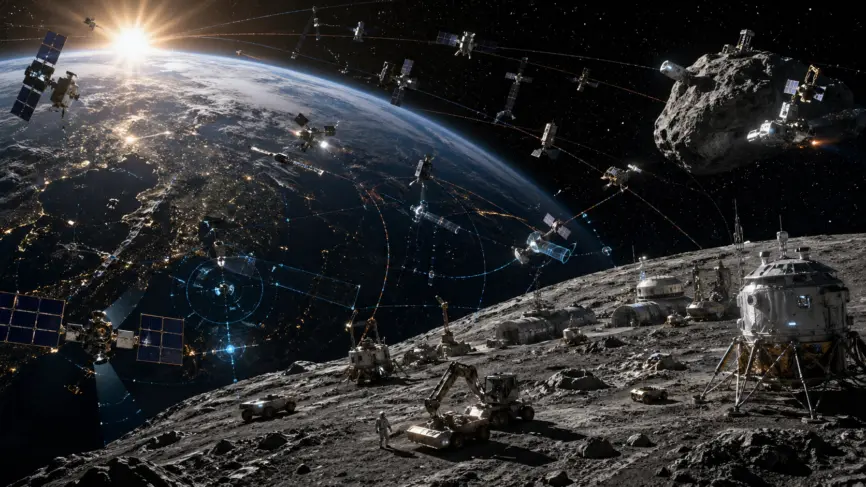
For a long time, outer space was imagined as humanity’s great horizon of hope: a realm of science, discovery, and the belief that beyond Earth’s conflicts something larger and nobler might exist. That image is fading fast. Today, orbit is no longer viewed only as a scientific arena, but as strategic terrain. The Moon is no longer just a symbol; it is a target again. Asteroids are no longer just celestial bodies; they are potential resource fields. And space is no longer merely a setting for exploration, but increasingly a domain shaped by power politics, security interests, and economic competition. At first glance, the legal foundation seems clear. Under the U.N. Outer Space Treaty, outer space — including the Moon and other celestial bodies — is not subject to national appropriation by claim of sovereignty, use, or occupation. At the same time, the treaty framework affirms that outer space shall be free for exploration and use by all states. In plain terms: no country can simply “own” the Moon as territory. But many states and private actors are already working to shape rules that secure access, use, and economic advantage in practice. That is where the real struggle over space begins.
That grey zone is becoming more visible every year. The Artemis Accords, launched in 2020 by NASA and partner nations, are meant to establish principles for safe and peaceful civil space activity. On April 20, 2026, Latvia became the 62nd nation to sign them. The accords emphasize transparency, registration, scientific data sharing, emergency assistance, preservation of space heritage, debris mitigation, and explicitly the use of space resources. They also introduce “safety zones” — operational areas where activities are coordinated to avoid harmful interference. Formally, these zones are presented as tools of safety and due regard. Politically, however, they can also be read as a preview of future spheres of influence in places where resources, infrastructure, and strategic positioning may one day become extremely valuable. This is why the resource issue matters so much. NASA states that the ability to extract and use resources on the Moon, Mars, and asteroids is “critical” for safe and sustainable exploration and development. Luxembourg goes even further. According to the Luxembourg government, it became the first country in Europe and the second in the world to create, through its 2017 law, a legal framework recognizing that space resources may be appropriated. That marks a genuine turning point. Because even if no state may claim the Moon itself as sovereign property, the debate is clearly shifting toward a different question: who owns what is taken from it? Whoever extracts first creates facts. Whoever sets the rules of use may not own the celestial body itself — but may still control the economic leverage around it.
That shift changes the moral narrative of spaceflight as well. The older ideal of “humanity in space” is gradually being replaced by a race for standards, infrastructure, and access. Space may legally belong to no one. In practice, however, states, agencies, and corporations are already trying to shape the terms of use through agreements, national legal frameworks, missions, landers, communications systems, and future supply routes. In space, possession does not begin with a flag. It begins with rule-setting, presence, and logistical control.
There is also a darker trend: militarization. The Outer Space Treaty prohibits placing nuclear weapons and other weapons of mass destruction in orbit. But that does not mean space has remained politically innocent. CSIS reported in 2025 continued development of counterspace capabilities, widespread GPS jamming and spoofing in and around conflict zones, and increasingly advanced maneuvering by Chinese and Russian satellites that could be relevant to future space warfare. Space has therefore become a military force multiplier: whoever controls communications, navigation, reconnaissance, and timing does not merely control satellites anymore — they shape the battlefield below.
That is why the question “Who owns space?” is more deceptive than it sounds. The legally precise answer is: no one as a national sovereign owner. The more realistic answer is: space is already being divided — not through old-style territorial maps, but through technology, agreements, security architecture, and economic dominance. Whoever controls launch capacity, defines standards, extracts resources, establishes safety practices, and builds long-term presence creates a new form of power in the twenty-first century. Not colonialism by gunboat, but colonialism by lander, data, and operating rights.
And that is precisely why space is no longer a distant science-fiction subject. It is a mirror of Earth. Everything that has shaped humanity below — competition, hope, expansion, fear, ingenuity, ambition, and the hunt for scarce resources — is rising upward with us. The real future question is not simply whether we return to the Moon or reach Mars. It is what kind of civilization arrives there: one that treats space as a shared domain, or one that turns it into the next great prize zone.