The New Class Society of the Future
Txt engl.
The New Class Society of the Future
Will AI Spread Prosperity – or Deepen the
Divide Between Winners and the Superfluous?
Science fiction rarely asks only what the
future might look like. Good science fiction asks something far more important:
Who will that future belong to? Will it belong to all of humanity? Or
only to those who have access to technology, knowledge, power, data, energy and
artificial intelligence? This question lies at the heart of many visions
of the future – and it also touches the world of Paradise 4.0. Because
even if humanity one day finds a new home, even if it begins again on a
distant, Earth-like world such as Hope, it almost always takes one thing
with it: its old mistakes. The dream of a fresh start is immense. A new
world. New cities. New rules. New hope. No ruined Earth, no ancient wars, no
inherited structures of power. Yet this is precisely where the true tension of
science fiction begins: What happens when humanity changes planets, but not
its way of thinking?
Hope – A New World, But No Simple Paradise
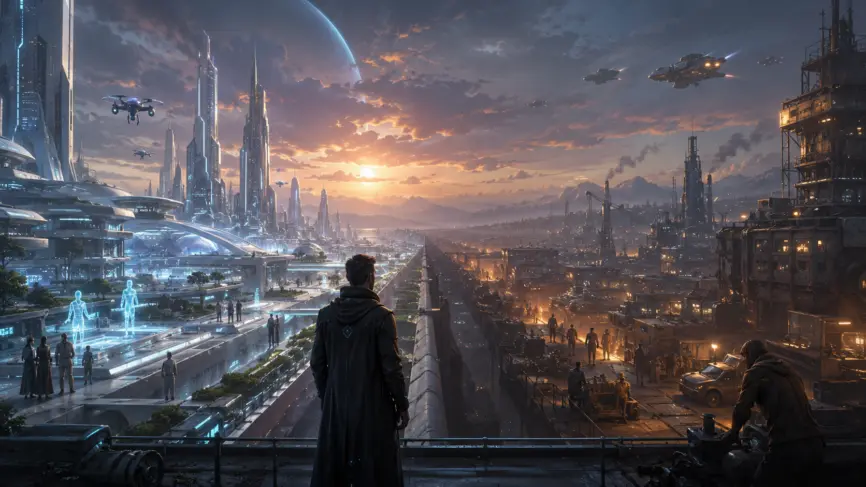
In Paradise 4.0, Hope is more
than just another planet. Hope is a promise. A possibility. Perhaps even
humanity’s last great attempt to reinvent itself. But a new world does not
automatically mean a fairer world. On Hope, too, resources must be distributed.
Power centres emerge. There are people who protect, build, organise, rule or
control. And there are also those who stand at the margins, who are expected
merely to function, who are not asked when decisions about their future are
made.
Added to this is the threat of the Crashers
– a kind of pirate force that attacks, exploits or seeks to destroy this
fragile new order. They stand for an old truth: where there is property, there
is theft. Where there is technology, there is abuse. Where there is hope, there
are always those who wish to profit from it. Hope is therefore not a naive
paradise. It is a testing ground. A mirror. A place where it becomes clear
whether humanity has learned from its mistakes – or whether it will simply
rebuild its old class society beneath a new sky.
AI as a Promise: Prosperity for All?
Today, artificial intelligence is often
described as a tool of progress. It can detect diseases earlier, improve
production processes, accelerate research, make education more accessible,
enable translation, support creative work and manage complex systems. In an
ideal future, AI could indeed help to distribute prosperity more widely. It
could take over dangerous work, improve medical care, optimise food production,
manage energy more fairly and free people from monotonous labour. Such an AI
would not be humanity’s ruler, but its tool. Not a replacement for humaneness,
but an extension of human possibility.
Yet science fiction must never stop at the
ideal image. It must ask the next question: Who owns this AI? Because if
artificial intelligence does not belong to everyone, but only to a handful of
corporations, governments or elites, then it will not automatically become a
tool of liberation. It may become the most powerful dividing line of the
future.
The Winners and the Superfluous
The most dangerous class society of the future
may no longer be defined solely by origin, wealth or education. It may be
defined by access.
Access to AI.
Access to data.
Access to computing power.
Access to genetic medicine.
Access to automated production.
Access to security systems.
Access to new habitats.
Access to data.
Access to computing power.
Access to genetic medicine.
Access to automated production.
Access to security systems.
Access to new habitats.
Those who possess this access will learn
faster, plan better, live healthier lives, work longer, produce more
efficiently and exercise greater power. Those who do not possess it will be
left behind. A new division emerges: No longer merely poor against rich. No
longer merely powerful against powerless.
But optimised against unoptimised. Connected against excluded. Automated against replaceable. Useful against superfluous. This is one of the great dystopian questions of our time: will AI liberate human beings – or will it evaluate them? When machines decide who is creditworthy, who is allowed to work, who is monitored, who is protected, who receives access and who does not, a future emerges in which people are no longer merely citizens. They become data sets. Profiles. Probabilities. And perhaps, one day: waste.
Paradise 4.0 and the Old Human Question
In the world of Paradise 4.0, this
question becomes especially compelling because Hope could, in theory, be a
place of true renewal. A new society could learn from the ruins of the old
systems. It could use AI fairly, limit power, share resources and prevent a
small elite from deciding the lives of everyone else. But this is precisely the
conflict. Every new world needs order. Every order needs control. And every
form of control creates the temptation to divide human beings: into valuable
and less valuable, into system-relevant and disruptive, into protected and
expendable. The Crashers embody more than an external
threat. They also remind us that civilisation is never guaranteed. It must be
defended – not only against attacks from outside, but also against moral decay
from within. What good is a new world if the same mechanisms
arise upon it once again? What good is artificial intelligence if it merely
increases the power of the powerful? What good is Hope if hope belongs only to
those who can afford it?
Why Distant Worlds Remain Science Fiction
As fascinating as the idea of new Earth-like
worlds may be, real physics imposes immense limits on humanity. The distances
between the stars are so unimaginably vast that even journeys to relatively
nearby exoplanets remain almost inconceivable with present or foreseeable
technology. Light years are not poetic units of distance. They are cosmic
walls. And then there is an even deeper problem: time.
Civilisations arise, flourish and disappear.
Not in days or centuries, but often across thousands or millions of years. Even
if another intelligent species exists somewhere out there, it may already have
vanished by the time we discover its traces. Or it may only emerge long after
humanity itself has ceased to exist. Old and new civilisations could pass one
another by in the universe without ever meeting. Not because no one is there,
but because space and time prevent every encounter. Perhaps this is one of the
most melancholic ideas in science fiction: the universe may be full of stories
– and yet most of them will remain forever unreachable.
That is why journeys to distant worlds, the
founding of new colonies on planets such as Hope and encounters with alien
powers remain among the great imaginative territories of science fiction. Not
because they are scientifically arbitrary, but because they make visible,
through storytelling, what we often suppress here on Earth. In science fiction,
distant worlds are rarely just distant worlds. They are mirrors of our own.
The Real Journey Does Not Lead to the Stars
Perhaps the most important question is not
whether humanity will ever reach Hope. Perhaps the more important question is
whether it would deserve to. A species that exports its injustice does not
merely colonise new worlds. It infects them. A humanity that understands AI
only as a tool of control will not create a free civilisation among the stars.
It will take its old hierarchies with it, its old fears, its old elites and its
old victims.
Yet science fiction lives not only by warning
us. It also opens possibilities. AI could indeed help to build a fairer future.
It could democratise knowledge, improve medical care, rethink work and make
societies more resilient. But only if it does not become the property of the
few. Only if the human being remains at the centre. Not as a data point, but as
a being with dignity.
Paradise 4.0 therefore tells not only of a
future on a new world. It tells of the old decision every civilisation must
face: Do we build a paradise for everyone? Or merely a fortress for the
winners?
The future will not be decided by technology
alone. It will be decided by the question of who controls it. And perhaps that
is where true science fiction begins: not in the journey to the stars, but in
the realisation that humanity must change itself before it deserves new worlds.