
HOPE a new place for mankind
Worlds
Planet Hope – The Last Refuge of Humanity
System: Kepler-11
Distance from Earth: approx. 2,000 light-years
Population: about 9.4 million (as of 2198)
Main town: about 4.4 million (as of 2198)
Government: Presidential Democracy – currently under President Younger
Founded: 2101 (Second Great Exodus)
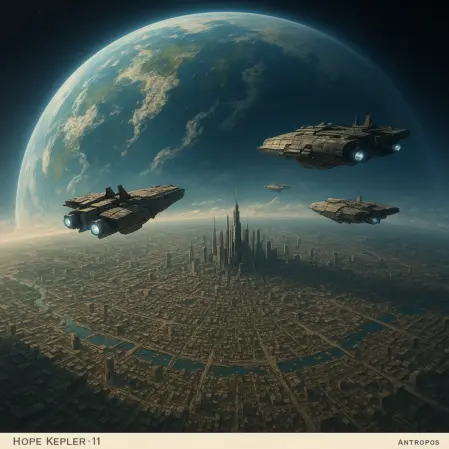
A New Chapter for Humankind
At the dawn of the 22nd century, as Earth crumbled under ecological collapse, political division, and economic decay, humanity embarked on its Second Great Exodus. Four monumental ships — Odyssey, Solitude, Horizon, and New Eden — left the dying home world behind, carrying the last hope of civilization toward the stars. Their destination: the distant Kepler-11 system, some 2,000 light-years away — a stellar cluster of six known planets orbiting a sunlike star. Among them was a blue, water-rich world, once catalogued simply as Kepler-11d. The settlers gave it a new name, a name born of faith and longing: Hope.
A World of Water and Light
Hope is a world that lives up to its name — at least at first glance. Vast oceans cover more than two-thirds of the surface, and lush green continents stretch like living veins beneath a pale golden sky. There is no native fauna, only an alien yet breathtaking flora, dense and crystalline, feeding on the planet’s unique light spectrum. Through the reactivation of cryogenically preserved DNA from Earth, humanity reintroduced a few animal species — cattle, swine, and certain bird types — forming the fragile foundation of agriculture on Hope. These creatures are more than livestock; they are symbols of endurance, living echoes of a lost world.
From Idealism to Power Games
The early years on Hope were defined by unity, courage, and the dream of a better civilization. But history, as it always does, found a way to repeat itself. Today, Hope is ruled by President Evan Younger, son of the colony’s founding leader Younger Senior. His election was never considered entirely democratic; critics accuse him of bypassing the Council of Thirteen, the planetary advisory body, to consolidate his personal authority. Under his leadership, Hope has evolved into a center of power, where democracy wears an increasingly fragile mask. Like Earth once before, the hunger for resources drives political expansion. Younger has deployed troops to the outer colonies — Binary Payne, New Hamburg, New London, Scute Epsilon, and Space Pioneer — officially for stabilization, but in truth for control.
Wars Beneath Alien Suns
In response to rising piracy and interplanetary terrorism, the Space Command established a special division over a decade ago: the Amazon Corps, or AZ-1 — an elite all-female military unit trained for precision strikes and rapid intervention. Under the command of Nathan White, former intelligence director and now Supreme Commander of the Space Command, the corps wages a relentless campaign against the Crashers — a sprawling network of ex-soldiers, smugglers, and deserters turned pirates and terrorists. A second division, AZ-2, is now in formation, trained by battle-hardened veterans who have seen war under alien suns and returned to prepare the next generation.
Technology and Progress
Hope’s Engineer Corps has achieved in less than a century what once took Earth millennia. The new starship drives developed here are faster, more efficient, and capable of reaching 3,000 light-years with minimal energy loss. Interstellar trade between the colonies has flourished — though increasingly under state supervision and military escort. Outposts with fewer than 3,000 inhabitants are not officially recognized as colonies but are known as Human Spots — independent settlements surviving without government support. These enclaves have become havens for idealists, renegades, and dreamers — the silent frontier of a new age.
Hope – More Than a Name
Despite political decay, resource wars, and the tightening grip of authority, Hope remains a symbol of human survival. Its name still carries the promise that began it all — for hope never dies.