HOPE a new place for mankind
Worlds of P4.0
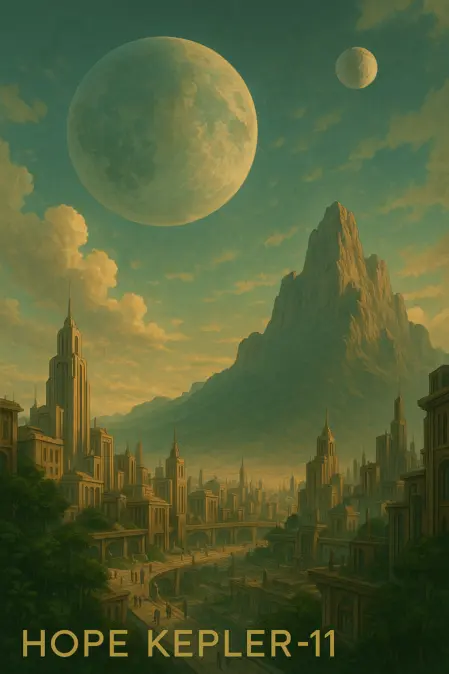
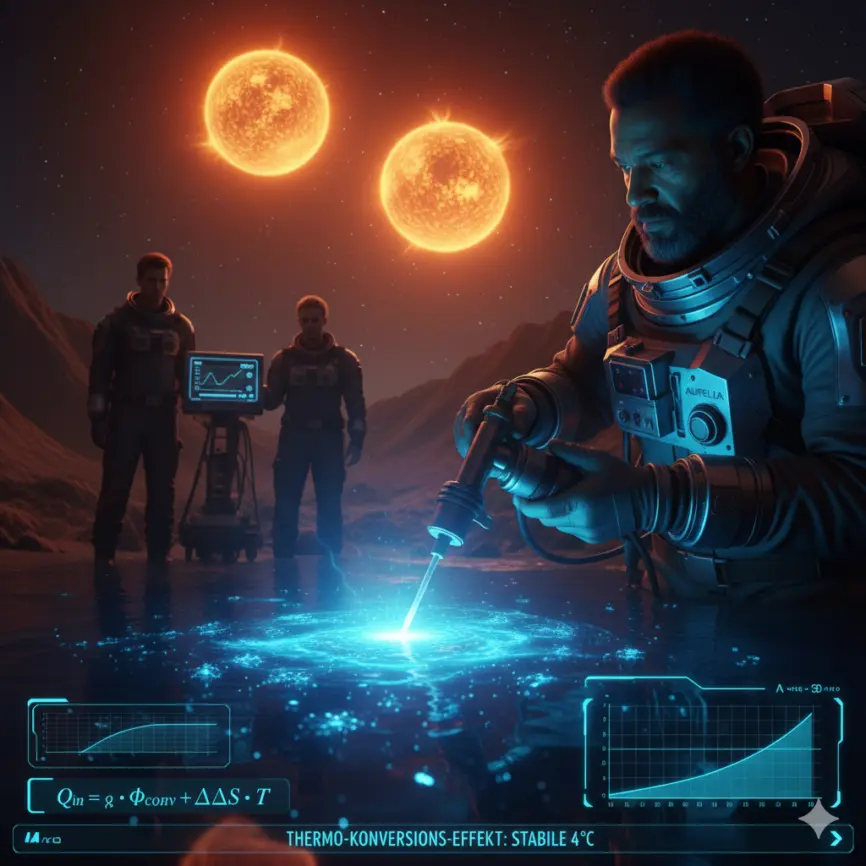
Planet Hope – Humanity’s last refuge! From the science fiction series “PARADIES 4.0”!
System: Kepler-452
Distance from Earth: approx. 2000 light-years
Population: approx. 9.4 million people (as of 2198)
Capital: Antropos, with approx. 4.4 million people (as of 2198)
Government: Presidential democracy – currently under President Evan Younger
Year founded: 2101 (Second Great Voyage)
A new chapter for humanity
As Earth groaned under the weight of ecological, political and economic collapse at the start of the 22nd century, humanity set out on its Second Great Voyage. Four gigantic spaceships – the Odyssey, the Solitude, the Horizon and the New Eden – left their homeworld in 2101, in search of a place where long-term survival could be secured. Their destination: the distant Kepler-11 system, 2,000 light-years away, comprising six planets orbiting a sun-like star. Among them was a blue, water-rich planet that astronomers had once simply and matter-of-factly named Kepler-11d – until the colonists gave it a new name: Hope.
A world of water and light
Hope is a planet that lives up to its name – at least at first glance. Its oceans cover more than two-thirds of its surface, and vast green continents stretch across the world like living veins. There is no native wildlife, only a dense, breathtakingly beautiful flora that winds its way like a primeval forest of chlorophyll and crystalline structures beneath an alien sky. It was only through the revival of frozen DNA samples from Earth that livestock reappeared here: cattle, pigs and a few species of bird. Today, they form the basis of Hope’s food supply – and are, at the same time, symbols of human perseverance.
From Idealism to Power Struggles
The early years on Hope were characterised by unity and determination. Millions of people built a new society, free from the mistakes of the past. Yet history repeated itself. Today, the planet is ruled by President Evan Younger – the son of the colony’s founder, Younger Senior. His election was never regarded as entirely democratic; critics accuse him of regularly bypassing the Council of Thirteen, the colony’s advisory body. Under his leadership, Hope has developed into a centre of power that is taking on increasingly autocratic traits. As was once the case on Earth, the quest for resources is becoming the driving force behind political conflicts here too. Younger is deploying troops to remote colonies – such as Binary Payne, New Hamburg, New London, Scute Epsilon and Space Pioneer – officially for stabilisation, but in reality to exert control.
Wars under a foreign sun
In response to rising piracy and terrorist attacks, Space Command established the Amazon Corps – AZ-1 for short – a few years ago. This elite unit, comprising exclusively female soldiers, was created to intervene where regular troops were overwhelmed. Under the command of Nathan White, the former head of intelligence who has since risen to become Commander-in-Chief of Space Command, the Corps is engaged in fierce battles against a group of space pirates known as the Crasher – a loosely organised but dangerous network of renegade mercenaries, smugglers and former colonists. The second Corps, AZ-2, is currently being formed, trained by female veterans who have already experienced blood and fire beneath alien stars.
Technology and Progress
The technical developments on Hope are remarkable. In less than a century, the Technicians’ Corps has revolutionised spacecraft propulsion. New models now have a range of over 3,000 light-years whilst consuming a fraction of the energy used by earlier generations. Interstellar trade between the colonies has consequently multiplied – even if it is increasingly under government control. Colonies with fewer than 3,000 inhabitants are not officially recognised and are merely regarded as ‘Human Spots’ – independent outposts that must manage without state support. These communities form the backbone of a new, quiet movement that dreams once more of freedom.
Hope – more than just a name
Despite political tensions, power struggles and smouldering conflicts, Hope remains a symbol of humanity’s survival. Its name says it all – for hope never dies.